Improving the fortunes of TB patients...


This week we focus on East Fortune Hospital. During the First World War an airship station and airfield were built in East Fortune, Drem, in East Lothian. After the War there was an upsurge in cases of tuberculosis (TB) and before the development of antibiotics, treatment was best carried out in sanatoriums in countryside air, away from populated areas to prevent the infection of others. The airfield, with its rural location and good road access, therefore was an ideal location for a TB hospital and East Fortune Hospital was duly opened in 1922 using part of the site.

During World War II, East Fortune patients were transferred to an annexe of Bangour General Hospital. From 1956, mentally handicapped children began to be cared for at the hospital and at the same time, concerted efforts in the cities of Scotland to identify and treat the majority of people with TB early resulted in a corresponding reduction in such patients at East Fortune. From 1974, the Hospital came under the control of the North Lothian District of Lothian Health Board and in 1997, East Fortune finally closed and its remaining patients were transferred to Roodlands Hospital, Haddington.
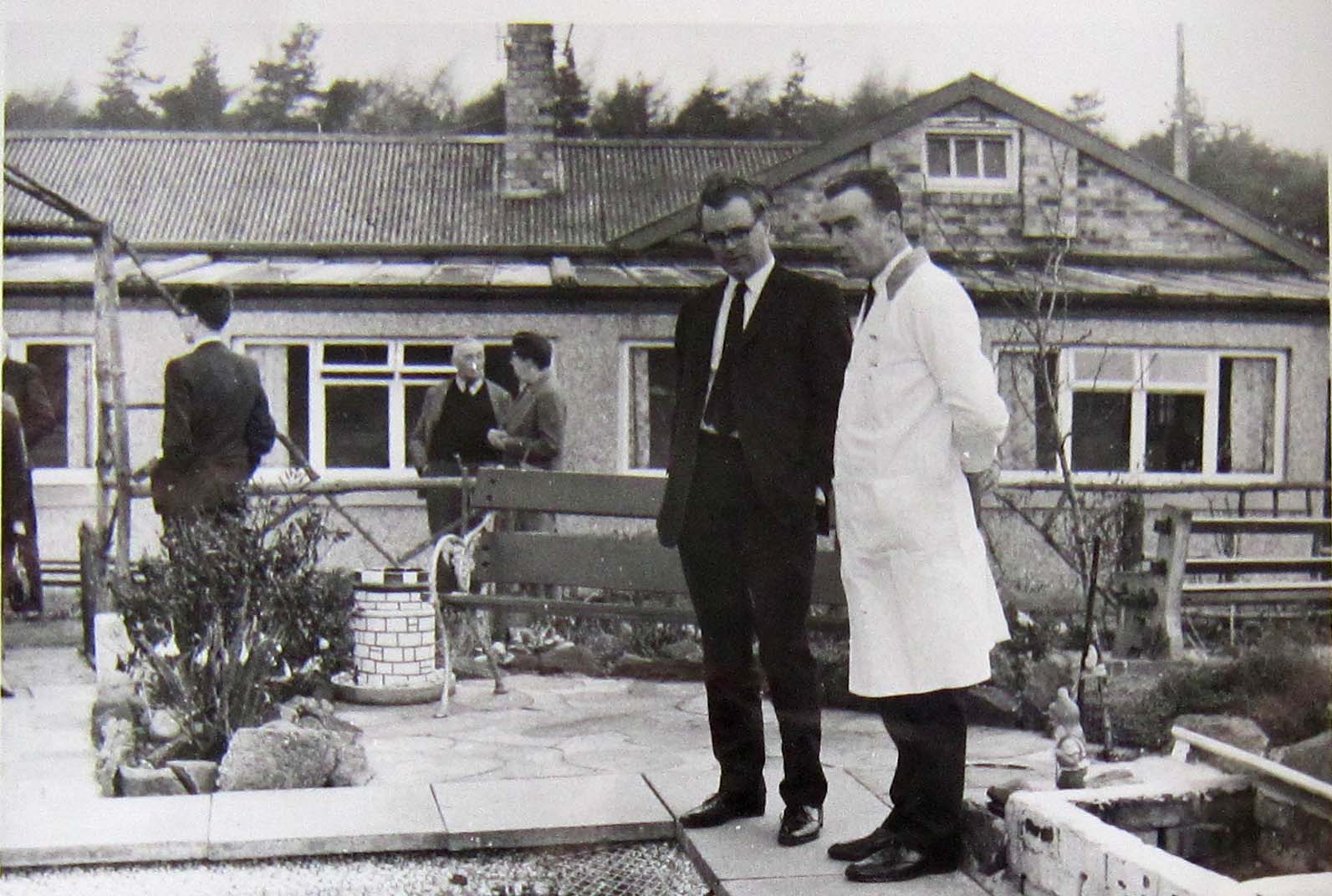
 
Patients and staff, c.1950s
LHSA’s records consist mainly of patient admission, discharge and death registers and a small number of case notes covering the years 1922 - 1974. Some photographs have also recently been accessioned and the images from approximately the late 1950s show staff and patients gathered round a newly constructed ornamental garden in the grounds of the hospital, with its distinctive huts in the background.
The ornamental garden, c.1950s

The History Room

It is a few weeks ago now that we took part in ‘The History Room’ in the Royal Edinburgh Hospital. Organised by Artlink, this was a special one-day event to commemorate the Hospital's bicentenary, and brought together staff, patients, and members of the community to learn more about the Royal Edinburgh's past.

We took along the first minute book, nineteenth-century editions of the Hospital magazine, the 'Morningside Mirror', photos and annual reports to exhibit alongside the memorabilia collected and held by the Hospital. ‘The History Room’ was fantastically well-attended, and was a great opportunity to talk to people in the Hospital and wider community about the LHSA collections and the work we do to protect and promote them.

It was so successful that 'The History Room' is being brought back by popular demand! On 6 September there will be a second chance to see it, to coincide with the Hospital’s fete.  For more information please click here - we hope to see you there!

Laura, the LHSA Archivist, showing a collection of Royal Edinburgh Hospital photos to a couple of members of staff
 

Wartime realities...

This week, our Project Archivist, Louise, talks about how Norman Dott’s case notes reflect the harsh conditions of the Second World War for those on the home front…
At present, I am cataloguing case notes created by neurosurgeon Norman Dott during the Second World War. During this period, Dott split his time between the Royal Infirmary of Edinburgh and Bangour General (Emergency Medical Service) Hospital in West Lothian. Dott had two surgical teams working to assess and treat military cases in Bangour whilst still working at the Royal Infirmary with civilian cases. Civilians would be assessed at the Infirmary and then transferred to Bangour for operation if one was needed.
The Royal Infirmary civilian cases might seem to be less gripping than the casualties of war treated by Dott at Bangour, but nothing could be further from the truth. Rather, they chronicle life on the home front and the unintended results of wartime necessity – they represent a different kind of wartime casualty.

For example, Dott commonly faced injuries sustained during the blackout, when a lack of street lighting could make a step off a tram hazardous and crossing the road after dark into a real undertaking. Inexperienced military drivers also created accidents and injuries. In this period, Dott treated a great many patients from reserved occupations, such as miners who suffered head and back injuries through accidents in the course of their dangerous work.
The war also had a clinical effect since even previously common medicines suffered from wartime shortages, and hospital staff members were stretched to the limit. In one 1944 case, a woman was described as “an indirect victim of the Second Front invasion” when her operation to reduce the pressure in her brain caused by hydrocephalus went disastrously wrong.  The Second Front invasion began on 6 June 1944, when Allied troops launched their invasion of occupied France in Normandy (the D-Day landings). The hydrocephalus operation also took place on this date. Half of Dott’s staff had left to meet expected military casualties on the previous day, and so the operation was left under-resourced. The patient died from pentothal poisoning, which had been administered as an anaesthetic for too long a period since the operation had been delayed by hours due to inexperienced theatre staff not making correct preparations for the procedure.
In these wartime case notes, the ways in which conflict touched people’s lives are ever-present, from mothers contacting Dott to urge him to write letters exempting their children from being called-up to accounts of evacuations, bombings and wartime home service. These details demonstrate the value of Dott’s case notes as records of strained social and economic realities – which could not help but effect clinical ones.
Image: GB237 Coll-32/A14 Dott (left) and Manchester neurosurgeon Sir Jeffrey Jefferson (centre) meet a Canadian medical officer at a meeting of the Society of British Neurosurgeons, 1944.


Medical Coding Training by experts medical coding training in hyderabad get training by experts